Can SharePoint Intranet be completely in our corporate identity?
The look and feel of an intranet plays an increasingly important role. Employees work in the platform on a daily basis and expect a modern environment that works clearly and fits the identity of the organization. As a result, we are increasingly being asked how much freedom there actually is within SharePoint when it comes to branding and design. Can you design a SharePoint intranet entirely in your own house style or are you limited to the standard Microsoft look and feel?
In this blog, we look at why branding within intranets is becoming increasingly important, what capabilities standard SharePoint offers today and where its limits lie. Then we will show how Fresh Intranet helps organizations get even more out of SharePoint branding.
Why is a corporate style intranet important?
For many organizations, an intranet has become the central place for internal communication, collaboration and information provision. Employees use it daily for news, documents, processes, HR information, projects and knowledge sharing. This is precisely why appearance plays an increasingly important role. An intranet that matches the corporate identity feels recognizable and familiar. It strengthens the identity of the organization and ensures that employees become more quickly involved in the platform. Especially in larger organizations or organizations with many different departments and locations, a consistent look helps create a single digital working environment.
In addition, user experience plays a big role. Modern employees unconsciously compare an intranet to websites and apps they use every day. An environment that is uncluttered, visually appealing and logically laid out often results in more adoption and use. Branding is therefore not just about “pretty,” but rather about recognizability, trust and ease of use.
What are the capabilities of standard SharePoint? Microsoft has made great strides in SharePoint design and branding in recent years. Modern SharePoint sites offer much more flexibility than before, and organizations today can already customize quite a lot without customization or development.
For example, SharePoint supports:
Themes and corporate identity colors
Custom logos and navigation
Full width sections
Flexible Sections
Vertical sections
Modern communication pages
Background Images
Webparts for news, events and quick links
Templates and design ideas
Responsive layouts for mobile use
For many organizations, this already provides a strong foundation. With clever combinations of sections, images, navigation and webparts, you can now build an intranet that looks much more modern and professional than was previously possible within SharePoint. Microsoft also continues to actively develop SharePoint. Functionalities such as Flexible Sections give more and more freedom to design pages more dynamically and to visually enhance content. This makes it increasingly easy to align an intranet with the organization’s look and communication needs.
Where are the limits of standard SharePoint?
Despite all the improvements, there also remain limitations within standard SharePoint branding. The basics are strong, but organizations that really want a lot of control over appearance, consistency and user experience often run into limits. For example, many components remain dependent on standard SharePoint builds and Microsoft components. This means that design freedom is sometimes more limited than organizations expect.
Consider, for example:
Limited control over certain layouts
Less extensive styling options per webpart
Navigation that is less flexible
Limitations in consistent branding across multiple sites
Less central control over design and templates
Dependence on standard SharePoint views.
Different pages quickly set up inconsistently
In addition, properly designing a SharePoint intranet often still requires a lot of knowledge of SharePoint itself. Flexibility has increased, but without clear guidelines, a jumble of layouts, colors and page layouts is also more likely to arise. That doesn’t mean that standard SharePoint is “not good enough.” For many organizations, it provides an excellent foundation. But organizations that focus more on internal communications, employee experience and a truly branded intranet often find that they begin to need additional features.
More branding possible for SharePoint thanks to Fresh Intranet
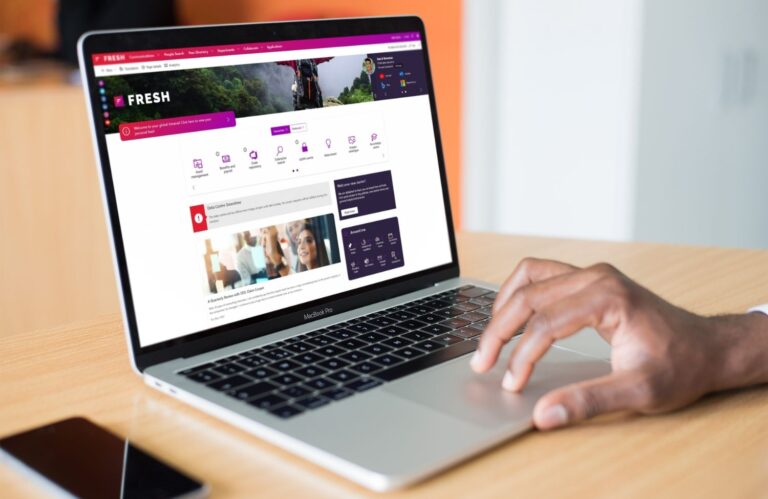
For organizations that want more freedom in terms of branding and styling, Fresh Intranet offers additional features on top of standard SharePoint. Fresh builds entirely on SharePoint and Microsoft 365, but adds an extensive extra layer for design, appearance and user experience. This preserves the strong basis of SharePoint, while allowing much more freedom in design and house style. With Fresh, organizations can make their intranet much more consistent with their own branding.
Consider, for example:
Central branding settings
More control over colors and styles
Consistent layouts across the intranet
More flexible navigation design
Expanded header and footer options
More freedom in page layouts
Dynamic and visually stronger homepages
More options for typography and content display
Display modes and hover effects
More control over appearance of news and content blocks
Consistent branding across multiple sites and departments
More visual freedom without custom development
As a result, an intranet feels less like a standard SharePoint environment and much more like a professional platform that fully reflects the identity of the organization. A major advantage of Fresh is that communications teams can manage much more themselves without relying on complex custom solutions. Branding, layouts and styling can be managed centrally, keeping pages more consistent and making the intranet look visually stronger.
In addition, Fresh continues to run entirely within Microsoft 365. So organizations continue to work within the familiar SharePoint environment, but are given many more opportunities to take the intranet to a higher level in terms of appearance and user experience.
A modern intranet is about more than just functionality
Whereas intranets used to be mainly practical information portals, today employees expect a modern digital workplace that is pleasant to work in, feels recognizable and connects to the organization. Branding plays an increasingly important role in this.
Standard SharePoint already offers many options for setting up a professional intranet. For many organizations, this is an excellent basis. But organizations seeking greater flexibility, consistency and a stronger employee experience are increasingly looking at solutions such as Fresh Intranet.