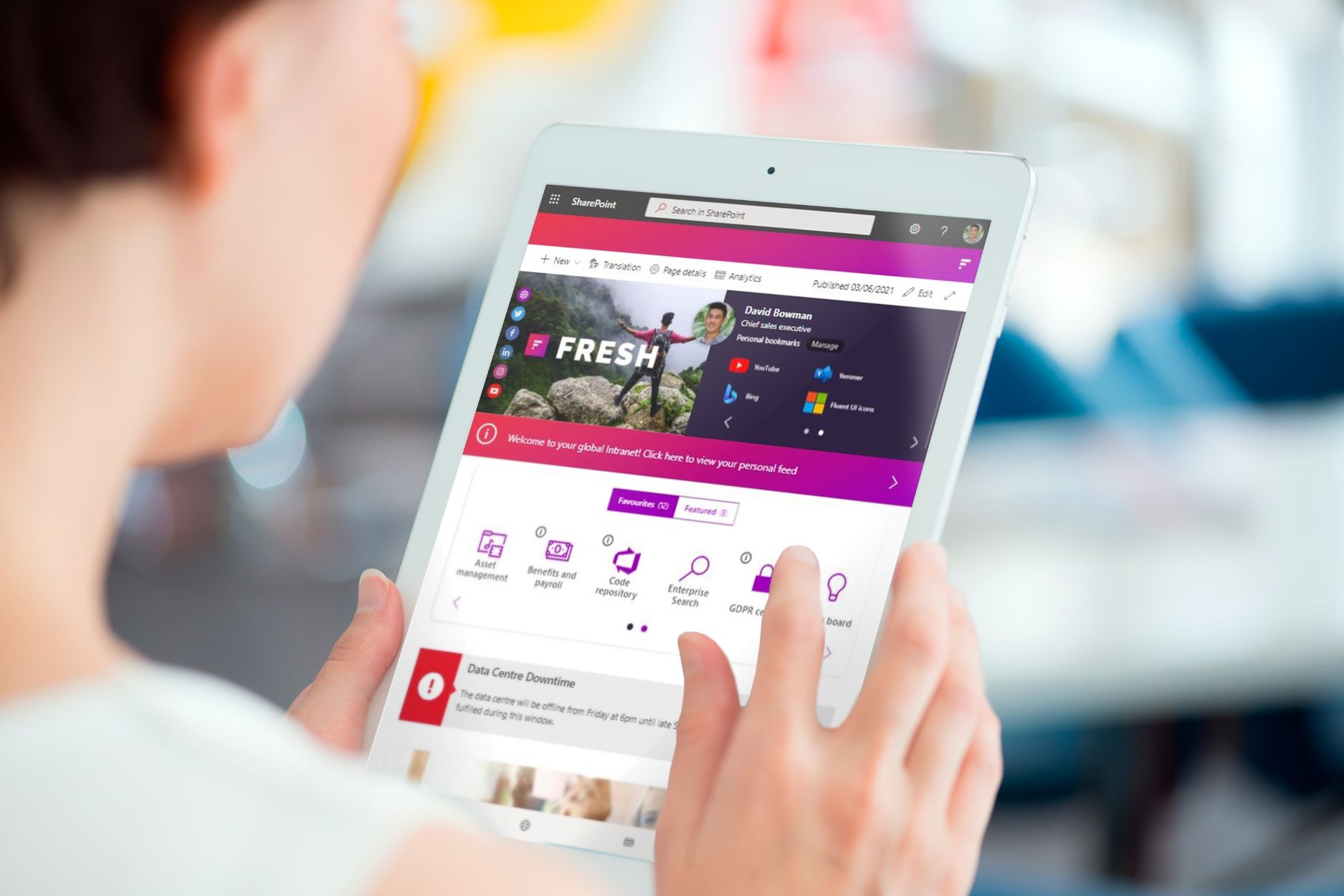
Can I manage SharePoint Intranet without IT help (or IT knowledge) thanks to Fresh?
More and more organizations with a Microsoft 365 license are opting for a SharePoint-based intranet. Wise choice; SharePoint is, in fact, already part of Microsoft 365, which allows organizations to get the most out of licenses they already have anyway. In addition, the platform is secure, scalable and connects well with the rest of the digital workplace.
Yet from communications and HR, you often hear a different tune. They are the ones n who must use and manage the intranet on a daily basis. And this is where doubts frequently arise. Because standard SharePoint is often seen as complex, technical and difficult to manage without IT knowledge.
That’s exactly where Fresh Intranet makes a difference. Fresh builds on SharePoint and adds not only functionalities, but also extensive management options. This creates an intranet that does run within Microsoft 365, but at the same time is easy for communication professionals to manage. Without the need for technical knowledge or constant help from IT.
Why standard SharePoint is often difficult for communication
SharePoint provides a strong foundation for collaboration, document management and information storage within Microsoft 365. As a result, it is also used by many organizations as the foundation for an intranet. But in practice, managing an intranet often requires a different kind of management than, say at a document management in SharePoint. With an intranet goes it primarily about the dailye behhonor of content and communication towards employees.
IT departments are quite capable of setting up SharePoint technically. But once the intranet is live, day-to-day management shifts to the communicationspecialists or HR. And that is precisely where the challenge arises. Because without SharePoint –knowledge, managing a SharePoint intranet can quickly become complex. Consider customizing the navigation or managing page–templates.
How Fresh Intranet makes managing SharePoint Intranet easier
Fresh Intranet builds on SharePoint’s strong foundation and adds functionality and management capabilities designed specifically for intranet use. Where standard SharePoint is primarily focused on collaboration and document management, it focuses Fresh focuses precisely on managing intranet content and internal communications on a daily basis to provide employees with the right information.
With Fresh, it means that tasks that would normally feel technical or complex become much simpler within SharePoint. Communications teams gain more control over their intranet and can perform many tasks independently, without the need for IT support all the time.
So what exactly does Fresh add?
1. A central place for communication management
One of the biggest differences from standard SharePoint is that Fresh provides a central place where the communications department or employee can manage the intranet. In Fresh, this is called the Comms Centre. Here, news items, notifications and events are created and managed from one conveniently arranged environment.
For communications teams, this means they no longer have to navigate through different SharePoint sites to manage content. Everything related to internal communications comes together in one place.
From this central point, communication can, for example:
Publish news releases and updates
Managing important notifications
Adding events to the intranet
Maintain overview of all communication content
2. Publish content through a guided process
Within Fresh, communications teams can create new pages or news items through a Content Creation Wizard. Instead of an editor having to think for himself about where to save a page, what metadata is needed or how to set up the formatting, Fresh guides this process step by step.
For example, the editor first chooses the type of content he or she wants to create, such as a news item or an intranet page. Then the wizard helps add important information such as title, image, target audience and publication date.
The benefits are:
Publish new content faster
Pages are placed in the right place via a predetermined template
Less error prone
Consistent structure of intranet content
3. Overview and planning of communications
With many intranets, over time a jumble of pages, news items and updates develops. It is then difficult for communications to keep track of what has already been published and what is still planned.
To this end, Fresh offers an editorial calendar that brings together all communication content. In it, communication teams can see at a glance which news items, pages or notifications are planned and when they will be published.
This helps with, for example:
Planning news releases and internal campaigns
Preventing important messages from being published simultaneously
Maintaining oversight of all intranet content
4. Understanding content usage and impact
Another challenge with an intranet is that the communications department often has little insight into what employees actually read or use.
Fresh provides comprehensive analytics and content reporting for this purpose. For example, communications teams can see how many times a page is viewed, which news items are popular and which topics are frequently searched for.
This helps communication to:
To understand what employees care about
Improve content based on usage
Make better informed choices
5. Keeping a grip on the timeliness of information
Often, over time, another problem arises on an intranet: outdated information. Pages persist for years without anyone knowing if the content is still accurate.
Fresh helps organizations get a better handle on this through content reporting and governance tools. For example, it can track who owns certain content and when a page was last modified.
In addition, multiple pages or documents can be updated simultaneously via bulk actions. This makes managing large amounts of intranet content much more efficient. For communications teams, this means the intranet stays current without the need for complicated management processes.
Conclusion: Fresh makes managing SharePoint Intranet much easier
In practice, managing an intranet requires more than just a technically well-designed platform. Above all, it must be easy to manage for the teams that work with content and internal communications on a daily basis.
Fresh Intranet extends SharePoint with functionalities that make this possible. This allows communications teams to largely manage their intranet themselves, without constantly depending on IT. Wondering how Fresh Intranet works in practice? Read more about Fresh Intranet or schedule a demo here.